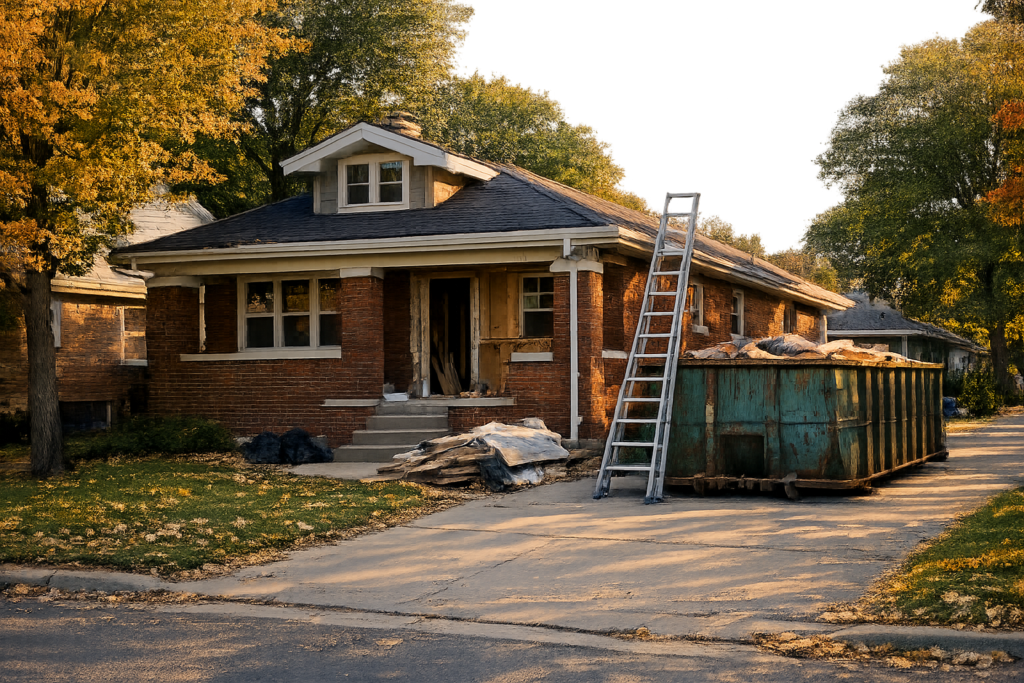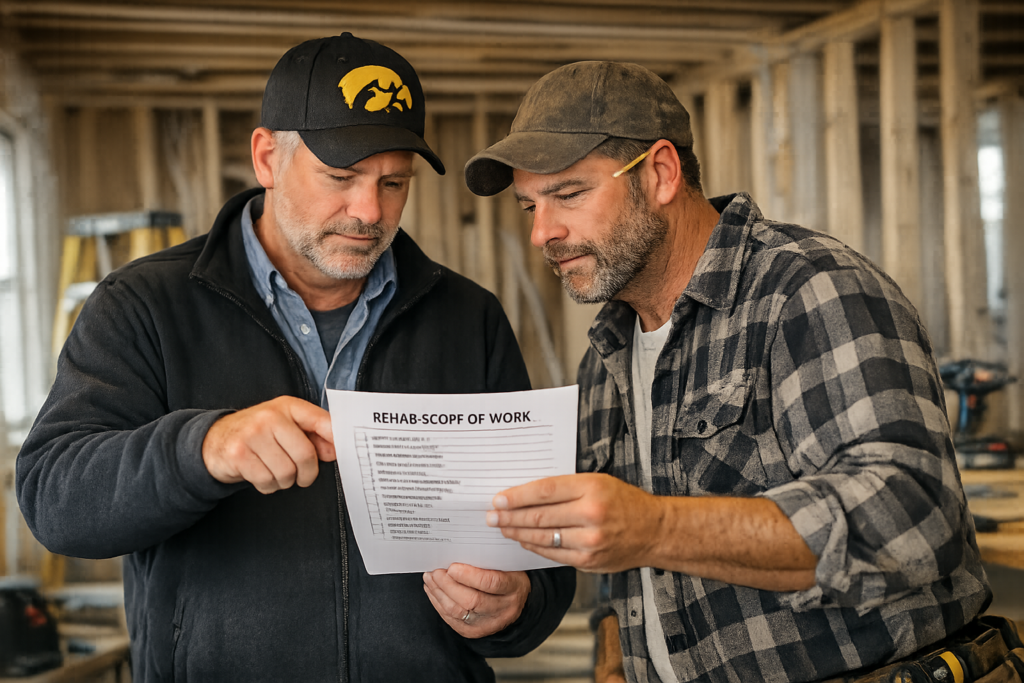

Most of the flips I watch go sideways don’t fail on the purchase price. They fail somewhere between the sledgehammer and the final walk-through, when nobody wrote down exactly what the contractor was supposed to do. A scope of work for a fix and flip is the document that turns your rehab budget from a guess into a plan. Skip it, and you’re negotiating change orders after demo day, with zero leverage and a contractor who already knows you’re stuck. I’ve seen Iowa investors lose five figures of margin to a scope that lived in someone’s head instead of on paper. Here’s how I build mine before a single wall comes down.
What a Real Scope of Work Looks Like on a Fix and Flip
A scope of work is a document that lists every task a rehab requires, the materials and finish level for each task, and who is responsible for it. It’s not a punch list, and it’s not a verbal walkthrough sealed with a handshake. It’s a line-by-line contract exhibit your contractor prices against and you both sign before a permit gets pulled.
On a flip, the scope does two jobs. It sets the ceiling on what “done” means, so a contractor can’t quietly upgrade finishes you never asked for and bill you later. And it gives you a real number to underwrite against instead of a round figure a contractor tossed out over coffee.
The Line Items Every Iowa Scope of Work Needs
I break every scope into the same categories, whether the house is a 1950s ranch in Urbandale or a two-story in Norwalk that needs a full mechanical update:
- Structural and systems: roof, foundation, electrical panel, plumbing stack, furnace and AC, water heater
- Exterior: siding, windows, gutters, driveway, landscaping and grading
- Interior finishes: flooring by room, paint, trim, doors, cabinets and countertops
- Kitchen and bath specifics: fixture brand and model, tile size, appliance package
- Permits and inspections: what’s required by the city, and who’s pulling them
Every line gets a material spec, not just a task name. “Replace kitchen flooring” invites an argument. “Replace kitchen flooring with 12mm luxury vinyl plank, mid-grade, contractor-supplied” doesn’t.
Turning the Scope of Work into a Draw Schedule
Once the scope is priced, it becomes the backbone of your rehab draw schedule. Instead of a lump sum up front, you tie each draw to a completed, inspected phase: demo and rough mechanicals, drywall and paint, flooring and trim, final punch list.
This keeps cash out of a contractor’s hands before the work justifies it, and it gives you a built-in checkpoint to catch a job drifting off schedule before it eats your holding costs.
Where Contractors Pad the Scope (And How to Catch It)
Cost overruns rarely show up as one big surprise. They show up as a dozen small ones: an “unexpected” plumbing issue that was visible at the walkthrough, a material upgrade nobody approved, a labor line that quietly grew between the bid and the invoice.
Three habits keep this in check on every deal I underwrite:
- Require a written change order, priced and signed, before any work outside the scope starts
- Walk the property at every draw request and compare it against the scope line by line, not against the invoice
- Keep a rehab cost library from past Iowa projects so you know when a bid is out of range before you agree to it
A Windsor Heights Example
I recently underwrote a rehab budget on a three-bedroom ranch in Windsor Heights where the scope ran fourteen line items and about $38,000 in projected rehab cost against a $260,000 ARV. Because the kitchen line specified cabinet brand, countertop material, and appliance tier up front, the contractor’s draw request matched the original bid almost dollar for dollar. The one change order, a cracked sewer lateral found during demo, got priced and signed before anyone touched it. That’s the difference a real scope makes. It doesn’t prevent surprises. It prices them before they become an argument.
Loan Terms for Your Iowa Rehab
When you’re financing the rehab portion of a flip, it helps to know what a lender will actually fund against your scope of work. Little Guy Loans structures fix and flip financing at up to 90% of purchase price, up to 100% of rehab costs, with a maximum of 70% of ARV controlling the loan amount. A detailed, accurately priced scope of work is what lets a lender underwrite your rehab budget with confidence instead of guessing at a round number.
FAQ
How do I create a scope of work for a fix and flip?
A scope of work for a fix and flip is a line-by-line document that lists every rehab task, the material and finish level for each one, and who is responsible for completing it, priced and signed by both the investor and the contractor before work begins.
What is a rehab draw schedule?
A rehab draw schedule is a payment plan that ties each contractor payment to a completed, inspected phase of the scope of work, such as demo, rough mechanicals, drywall, and final punch list, instead of a lump sum up front.
How do I avoid contractor cost overruns on a flip?
Avoiding contractor cost overruns starts with a detailed scope of work, a written and signed change order for anything outside that scope, and a walkthrough at every draw request to confirm the work matches what was priced.
A scope of work won’t make your flip immune to surprises. Cracked sewer laterals and hidden knob-and-tube wiring don’t care how detailed your document is. What it does is give you a fixed reference point, so every surprise gets priced and signed instead of absorbed into your margin without a conversation. Write it before you hire the contractor, not after the first draw request. On an Iowa flip, the rehab budget is often the difference between a good deal and a break-even one.